
Development on Beetroot has been stopped.
Beetroot answers the question of “who’s on aux?” — a shared queue that lets anyone at a gathering add songs, similar to SharePlay and Spotify Jams but across multiple music sources.
History
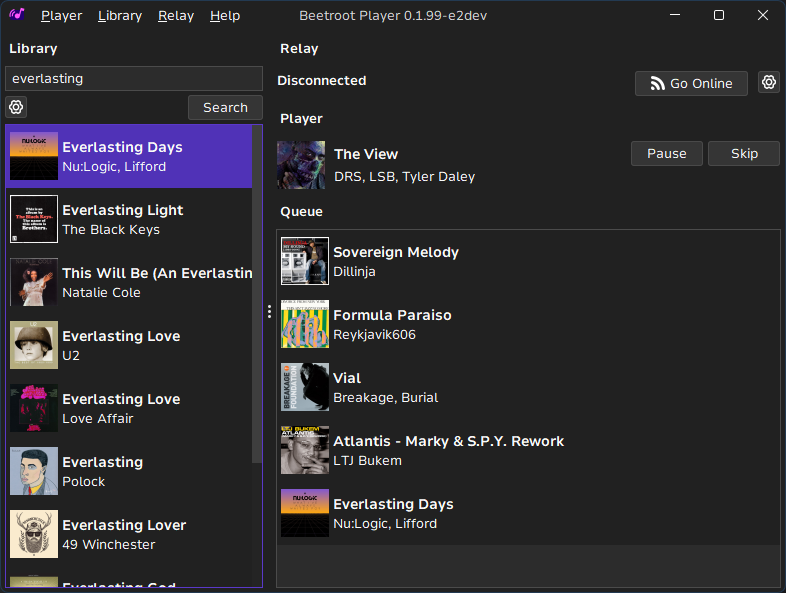
The very first project with the name of “Beetroot” was a program I wrote in 2016 to sort my music by its metadata.
The tagline was “It roots through your beats, so you don’t have to.”
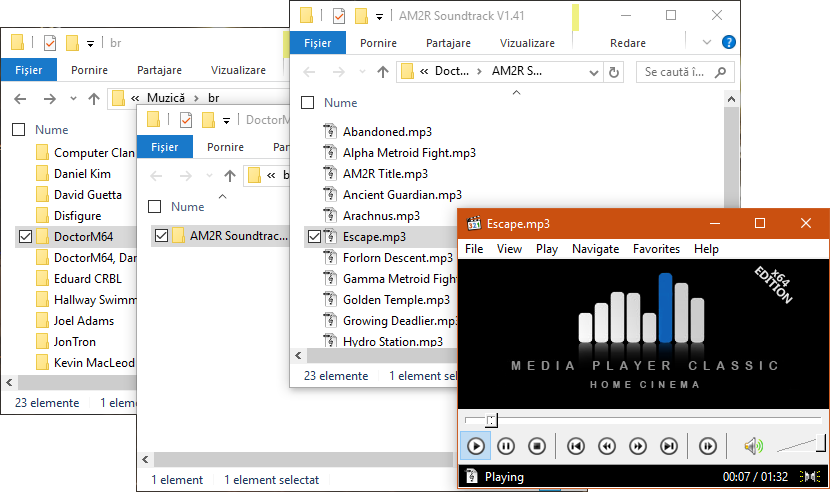
It had some development, I had toyed around with hosting an HTTP server out of the app to play my library remotely, but hadn’t gone past it much.
A couple of years later, I reused the name for an even better project idea.
2018 - Beetroot Player
I then created Beetroot Player in 2018, when I was in my last year of college1 with a simple goal in mind: “Allow party guests to queue tracks to the playlist.”
It was originally created with JavaScript on Electron; I quickly built out the user interface, library management, localisation, and playback, and was fairly happy with what was there.
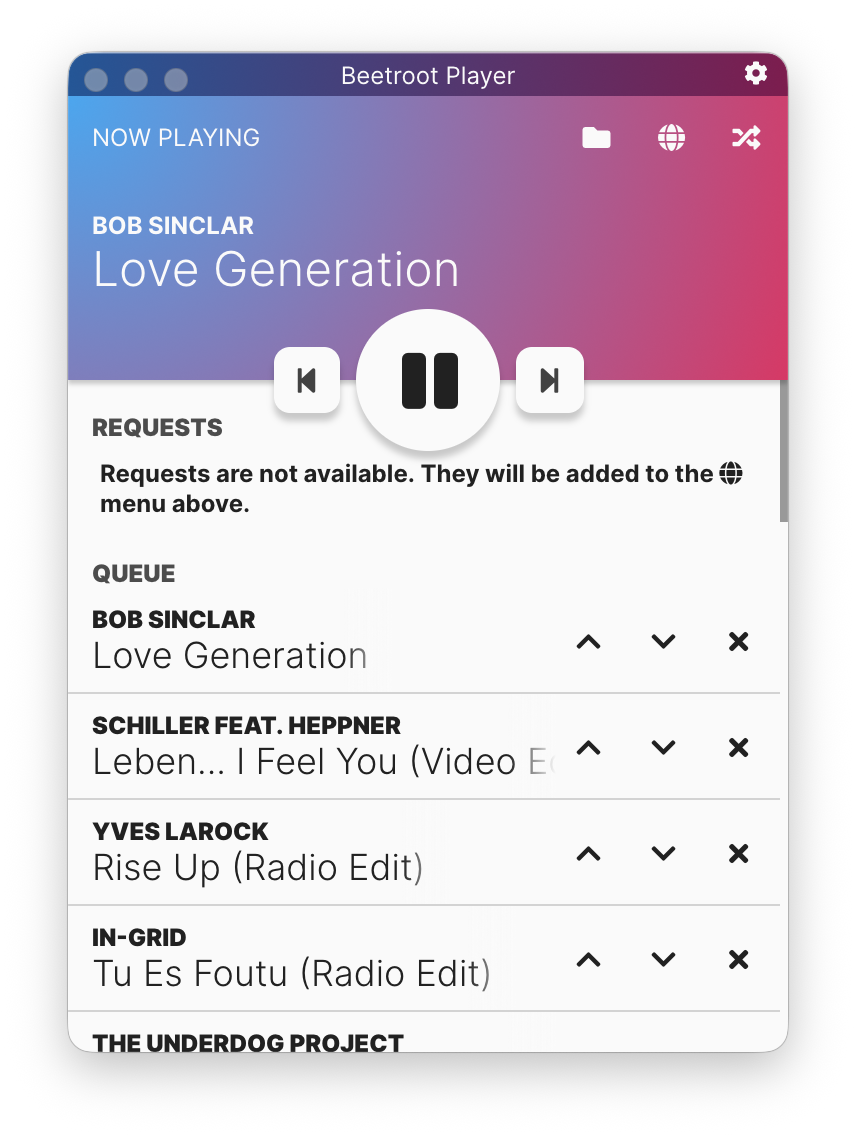
When I started work on the server connectivity, which was needed for the “having your guests queue tracks” bit, my inexperience left a lot of tech debt I didn’t know how to properly address at the time.
Looking back, if I had continued building it, the relay service would have been written in PHP and use SSE (Server-Sent Events), which would’ve caused its own issues.
Additionally, codec support was not uniform across platforms. A lot of music playback technology2 is locked behind software patents, which are enforced differently across the world, leading to having to install them manually on most Linux distributions, which I wanted to support.
With all that in mind, I worked on other projects, with more interesting problems in the meantime and stopped working on it as I was focusing more on my studies.
2020 - Phoenix
Having learned some software development during university, and with COVID having me at home most of the time, it was time to dust off this project.
This time around, I opted to go for native applications on each platform, starting with UWP on Windows. I was fairly excited too, because I had been a former Windows Phone user, and learned the basics of making apps3 on the platform — those skills transferred to UWP.
From the get-go, there were improvements. A clear data model, proper bindings, a nice media playback API, and the UX actually felt nice.
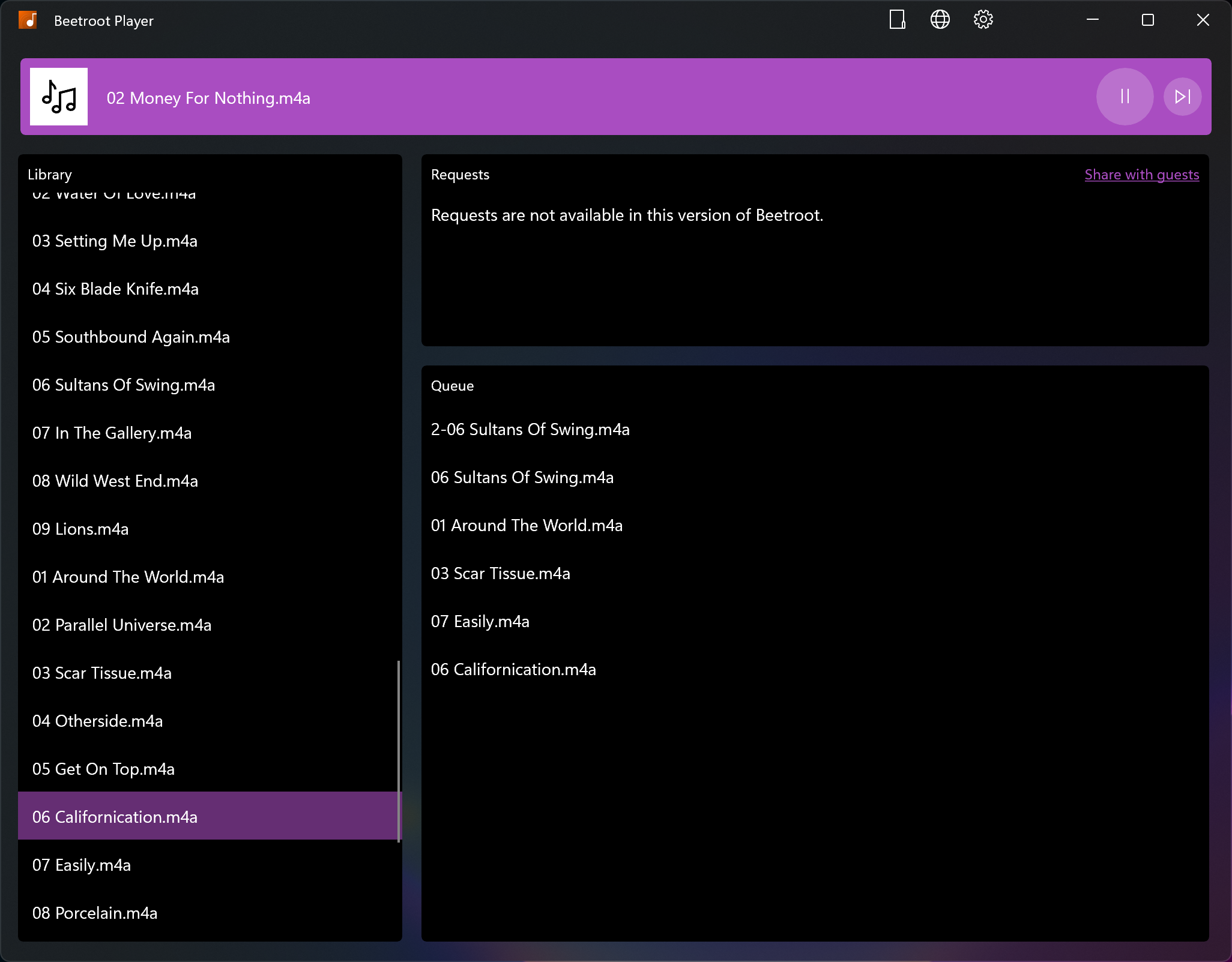
While working on the player app, I had also started work on the web service, going for TypeScript and Express. When I returned to the project later that year, I picked up the web service first — the plan being to get the relay sorted before returning to the app. By then though, UWP was fading in relevance, and the app side stayed shelved.
2023 - Beetroot Music
By this point, I was on my way to finishing university and had been working in software development for a bit. I had a much better sense of how to actually build something like this.
The key unlock was discovering librespot-java, an open-source reverse-engineered Spotify client. That’s what led me to choose Kotlin for the desktop app — the library was JVM-based, and it meant I could offer real Spotify playback without going through their official SDK. Mobile was Flutter, as both Spotify and Apple Music had libraries available there.


Given the licensing situation with those integrations, I went with an open-core model. The desktop app, Beetroot “Amen Break”, would be open-source with local library support and an open plugin ecosystem. A separate closed-source build would include the Spotify, Apple Music, and SoundCloud integrations. The mobile app and relay service followed a similar split — Deepcore and the command-line client NeuroFunk stayed open, the mobile app didn’t.
This was the most complete version of the project by some distance. The relay actually worked end-to-end. The plan was to develop in private and run open betas around parties I was hosting or helping set up — a fitting way to test it.
It stalled for a reason that, in hindsight, was always going to catch up with the project. When you’re building on top of services that haven’t agreed to support you, you’re at their mercy. YouTube changed their API mid-development. Spotify changed their login system — librespot eventually caught up, but the underlying Mercury protocol isn’t documented anywhere, and reverse-engineering it alone wasn’t something I was going to take on.
By the time I stepped back, SharePlay and Spotify Jams had both shipped as native features. The problem Beetroot set out to solve was solved, just not by me.
At some point I’ll come back, clean it up, and release the source — not to pick it up again, but to give the work somewhere to live.